Highlights of the Fort Smith Board of Directors Meeting 6/23/26

At the Fort Smith Board of Directors meeting held 6-23-26 and led by Director Settle in the absence of Mayor McGill and Vice Mayor Rego, the Board reviewed the five year Consolidated Plan for 2026-2030 that is required by the federal government for participation in the Community Development Block Grant (CDBG) and HOME grant programs.
Five year goals included in the plan include…
Rehabilitation of 60 owner-occupied homes
Assisting 41 households with homeownership
Creating or preserving 5 affordable housing units
Benefiting 3,190 residents through facilities and infrastructure improvements
Assisting 1250 persons experiencing homelessness
Assisting 6000 residents through public service programs
Director Kemp asked if organizations like World Changers are planning to help in the housing rehabilitation efforts. Director of Community Development Gabucci answered that World Changers had just finished their work this week and that they are the only organization that is involved. Director Kemp asked if there is a waiting list for the rehabilitation program. Gabucci answered that there is about a two month period for the approvals and bids process but that they do not have a long waiting list.

The Board discussed sending a letter to the Arkansas General Assembly requesting them to make a law requiring all hospitals to give City and County officials 180 days public notice before discontinuing major services. The request was inspired by the recent announcement that Baptist Health will be reducing their hospital services in Fort Smith, including a sudden closing of Labor and Delivery. This issue was discussed at the 3-31-26 meeting and tabled to allow area State legislators to be invited to a meeting to speak with the Board on the issue and was tabled again at the 4-28-26 meeting because legislators were not available to attend the meeting while the legislature was in session.
Director Christina Catsavis mentioned that California has recently passed similar legislation requiring 120 days notice and Maine has legislation pending. She pointed out that the issue is national and statewide, not just a Fort Smith issue. State Representative Richardson agreed.
State Representative Richardson asked what possible pushback has been heard about the proposed legislation. Director Christina Catsavis answered that when a department is staffed by a single doctor if that doctor decides to leave then the hospital may be unable to provide notification in time. She suggested that the law could be written to include dealing with that situation. She also said that she would be fine with a 90 day notification period and even accepting of a 60 day period if that is what is necessary to get the legislation passed.
State Representative Richardson said of the suggested legislation that he would be “happy to take it and work on it.”
Director Kemp suggested that the legislature also work on increasing insurance reimbursement rates to hospitals as they are lower in Arkansas than other states. State Representative Richardson added that the reimbursement rates are “one of the worst in the country.” He said that that was “definitely being identified for the next general session.” Director Christina Catsavis asked if previous legislation about adjusting reimbursements to be in line with the average for neighboring states would be brought back. State Representative Richardson said that it would.
Director Good expressed his desire to not tell private businesses how to run their business, but acknowledged that the health services are vitally important. He also mentioned that State Representative Richardson is on the Health Committee, so he is optimally positioned to work on the legislation. Director Christina Catsavis mentioned that the hospitals also feel different to her regarding telling private businesses how to run their business because they are tax exempt.

The Board discussed replacing the current Computer Aided Dispatch and Records Management System (CAD/RMS) from ProPhoenix with one from CentralSquare. Fort Smith contracted with ProPhoenix in 2023 and their system went live in 2025. In February of 2026, there was a breach by ProPhoenix that violated the terms of the contract and of FBI security policy. ProPhoenix is no longer trusted to continue and has been informed that when their contract is up for renewal in September of 2026 that it will not be renewed. The River Valley Communications Center and Fort Smith Fire and Police departments have selected CentralSquare, the provider that scored equal to ProPhoenix in the 2022 evaluation process, to replace ProPhoenix. The new system will cost $379,272.46 to implement. Funds for that implementation will come from the RVCC 911 fund balance and those funds will be replenished with money recovered from ProPhoenix through a settlement or litigation.
Director of Public Safety Communications Milam called the situation “very unfortunate” but said that no data was lost in the breach, but the additional actions that would need to be taken to keep using ProPhoenix in light of the breach are an undue burden. He said that they are seeking a return of the $1.2 million already spent on implementation from ProPhoenix. He said that CentralSquare is already a vendor with the City and can provide the same services as ProPhoenix. The implementation of CentralSquare could be expected to be completed by the end of this year or early next year. He said that with the incentives offered by CentralSquare, it will be less expensive for the first 5 years’ costs than ProPhoenix.
Director Christina Catsavis asked about the timeline on the breach of contract lawsuit. City Attorney Rowe said that if it goes to litigation that it is hard to predict and that it might take years. He said that Prophoenix has been notified that the City seeks the money back and that they have not responded to that request sent in April yet. He said that the City would try to resolve the issue without a lawsuit, but if a deal cannot be reached, that it would go to litigation. Director Martin asked Rowe if he feels “solid” about the breach of contract case. Rowe said that the contract requires ProPhoenix to comply with security protocols and that there has without a doubt been a breach. He said “I think the City’s position is good.”
Director Good said he is “very confident'“ that the City will be able to recover the funds. He called the situation “unfortunate” but said “We have to move forward.”
Director Settle asked if the ProPhoenix breach of security only affected Fort Smith. Milam said that it did. Director Settle asked what CAD/RMS system other similar areas use. Milam said that Benton and Pulaski counties use CentralSquare.
Director George Catsavis asked if both ProPhoenix and CentralSquare scored equally in the evaluation process originally why ProPhoenix was chosen over CentralSquare. Milam said that ProPhoenix edged out CentralSquare because of their dedicated fire system.
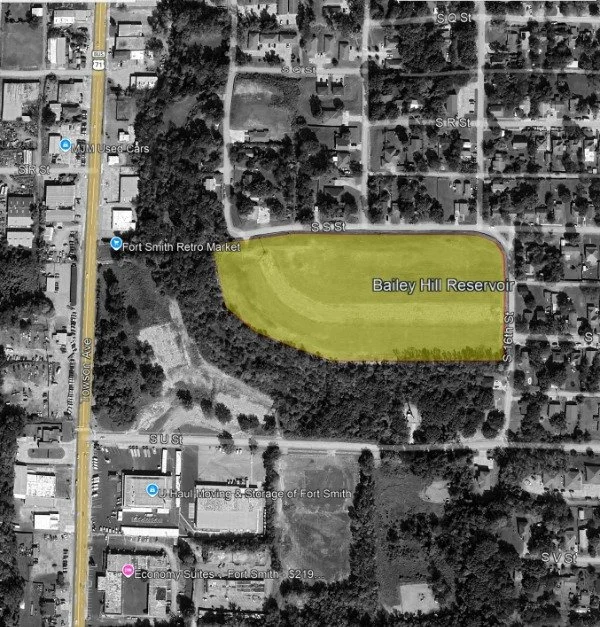
The Board discussed whether to enter into an agreement to provide Fort Smith Housing Authority with up to $1 million for streets and drainage for the Bailey Hill redevelopment project. The former reservoir site is being developed by the Fort Smith Housing Authority into 34 residential 2 and 3 bedroom houses to be sold to low and moderate income families. The funds for the streets and drainage in the agreement would come from the sales tax for streets and drainage. The spending for the project was included in the already approved Capital Improvements Plan.
The issue was discussed and tabled at the 6-16-26 meeting.
FSHA’s Mitch Minnick explained that houses would be built by the FSHA’s non-profit building company Compass Realty. Then 24 of the homes would be sold to buyers with incomes below 80% of the median area income and the other 10 to buyers with incomes from 80% to 120% of the median area income. The median income for a household of 4 is $61,450. All of the lots would be sold at market price and that FSHA would help find subsidies to make the houses affordable to the buyers. He offered the example that if a a house sold for $200,000, and the buyer only qualified for a mortgage for $170,00, the FSHA would find a way for them to find the other $30,000. Director Christina Catsavis asked where that subsidy would come from. Minnick said that it would come from the lender, CSCDC, or the FSHA issuing a second mortgage that would be forgiven over time but would come with a deed restriction for a period of years (the length depending on the size of the subsidy). The FSHA mission with the development is to make homeownership affordable for people who make too much for the federal rental assistance program (that only is available for incomes up to 50% of the median income) but who cannot afford to purchase a home on their own.
Minnick mentioned that the reservoir was a safety hazard and that no City funds were given when the land was donated. The only City commitment at the time of the donation was the commitment to partner on the streets and drainage expense. The demolition of the reservoir and site prep were done by the FSHA.
Director George Catsavis voiced concerns about the cost of spending saying “I’m having an issue with this.” and “A million bucks is a million bucks.” He asked if the houses would pay property tax. Minnick said that they would. He said that the development would bring in $58,500 per year in new property taxes. They would bring in $36,700 per year in new utility revenue. Over 30 years, the development would bring in $242,000 for just the City’s share of the property tax. Over 30 years it would bring in $1.1 million in utility revenue. He mentioned that the site has been off the tax rolls since the 1930s.
Director Martin asked about why the property was donated in 2012 to the FSHA instead of any other private developer. Minnick said that the property had sat vacant for over 20 years at that point as nothing could be done on it until the reservoir was demolished. The demolition and site prep necessary to use the property would have been “cost prohibitive” to a private for-profit developer. Director Martin asked if it still would have been cost prohibitive even with the additional million dollars for streets improvements given to another developer. With the $30,000 per lot cost for the streets and the $50,000 per lot cost for the demolition, Minnick said that it would be “not financially advantageous” for a developer.
Director Christina Catsavis asked if the City provides similar funding for Habitat for Humanity or other non-profit housing projects. Acting City Director Dingman said that others have not requested or received similar funding but that Habitat for Humanity typically does not do multiple lot neighborhood developments, only one or two houses at a time. He also noted that the Bailey Hill project involves a “derelict site” that other projects typically have not.
Director Christina Catsavis asked about the spending request being left out of the 2026 budget. Engineering Director Mittge said that it was left out “inadvertently.” He said that there are currently $40 million available in the streets tax account but that the cost would need to come out of a future project on a future budget. Director Christina Catsavis expressed concerns about the effect of the spending on the budget.
Director Good mentioned that in addition to the old reservoir site being “blight” that it had been a “safety issue.”
Director Settle asked if the buyers would be restricted from renting out the homes. Minnick assured that renting them would be prohibited via a deed restriction. They would need to be the buyer’s own primary residence. Director Settle suggested a claw-back provision in the deeds to help the City get back some of the infrastructure investment on each lot.