Highlights of the Fort Smith Board of Directors Meeting 5/19/26
The Fort Smith Board of Directors meeting held 5-19-26, began with the Citizens Forum in which residents may address the Board on any topic for up to 5 minutes.
Kim Fodge spoke and encouraged citizens to be involved with local issues.
Quinton Cunningham spoke about the results so far from the Future Fort Smith survey still in progress. He mentioned that of the 611 total responses so far, 220 said homelessness was a top priority and of those only 3 asked for punitive enforcement. He mentioned that 83% were concerned about utility affordability and that 52% said that they have little to no trust in the local government and 33% were neutral on their trust for the government. Cunningham also announced that he is running for the Board of Directors At-Large Position 5.
Shane McKinney, Eduardo Guzman, Bill Hollenbeck, Roy Loris, and Joey McCutchen spoke and advocated for the Board putting the change of form of City government from City Administrator to Mayor-Council on the November 2026 ballot.
Dan Williams spoke and expressed concerns about the lack of clarity and discrepancies in City financial reports. He also encouraged citizen involvement in local issues. He advocated for the change in the form of government.
Krystal Cadelli spoke and praised the reduction in the number of water leaks. She also spoke about prioritizing spending on water infrastructure and drainage. She advocated for seeking more grants for law enforcement. She suggested selling the former Crain Kia property and Burrough Road property to be able to afford hiring more police officers.
Jacqueline Hooper spoke about her experience having been turned away by Acting City Administrator Dingman’s office and expressed her concerns about the City Prosecutor not taking harassment complaints seriously and that his failure to protect her contributed to her being sexually assaulted. She also advocated for the change in the form of government.
Phil White spoke and voiced his opposition to the change in the form of government and to the Board putting it on the ballot. He suggested that the issue could go on the ballot via the citizen initiated petition. He voiced his view that running the City should not be a “popularity contest” but instead should be done by a professional City Administrator.
Chris Cadelli spoke and advocated for the change in form of government. He also mentioned that discussion about the cap on budget reserves was about a “problem that clearly doesn’t exist.”
Lavon Morton spoke and voiced his support for the accuracy of the City’s financial statements. He mentioned that no public company in the US audits quarterly (with once a year being the standard). He said that at a cost of $150,000 per quarter, quarterly audits would be a “gigantic waste of money.” He also suggested reversing the sewer charge charged on the utility bills for customers who watered their lawns in March.
Jason Skerbitz spoke and criticized the Board’s performance.
Jo Elsken spoke and suggested that if the form of government is to be changed that there should be a public education campaign regarding the details of the change in form. She also suggested that the Board pay be raised high enough for it to be the only job Directors have.
Glen Forte spoke and criticized the Acting City Administrator, Police Chief, and City Prosecutor.
The Board discussed 2 measures regarding placing a change in the form of City government from City Administrator to Mayor-Council on an election ballot for voters to vote on. One measure was to place the issue on the November 2026 general election ballot. The other was to place the issue on the November 2027 special election ballot. This issue was discussed at the 5-12-26 study session meeting.
Kim Fodge, Shane McKinney, Krystal Cadelli, Joey McCutchen, Chris Cadelli, and Carl Nevin all spoke in support of putting the issue on the 2026 ballot. Kristen Kitchens spoke in support of the change in form of government and also voiced her concerns about a natural gas well located in a flood zone.
Director Martin mentioned that he declined to sign the petition being circulated by citizens to put the change of form on the 2026 ballot because he “wanted to see the level of support” and that since then he seen “It’s there.” He voiced his concerns about the City Administrator being “in limbo” for another 18 months and that the hiring search for a City Administrator would “produce no fruit” if the issue is not on the ballot until 2027. He said that because the 2027 election would be an off-year election that the issue needs to be on the 2026 ballot where there will be a higher voter turnout.
Director Christina Catsavis also said that for the issue to have maximum voter turnout it needs to be on the 2026 ballot rather than the 2027. She voiced her view that 5 months is long enough for voters to study the issue before the election. She said that those against the 2026 ballot are possibly worried about the “incumbency advantage.”
Director Rego said that he wants the change in form. However, he said that he sees “no compelling logistical reason” for the Board to put it on the 2026 ballot. He advocated for putting it on the 2027 ballot to allow for more time to inform as many people as possible about the issue before the vote. He said that more time would lead to the issue winning when voted on.
Director Good agreed that putting it on the 2027 ballot would allow more citizens with busy lives more time to prepare before the vote. He said the issue is “not rocket science, but it’s a life changing decision.” He agreed with concerns about the City Administrator situation being in limbo. He voiced his support for the citizen led ballot petition.
Director Kemp mentioned the $35,000 spent on the nationwide hiring search for a City Administrator. He called his view in opposition to the change of form a “principle decision” stating that Board was elected to hire a City Administrator and that they should do that job. He said that he has not “seen a compelling case” as to why the Board would put the issue on the ballot. He voiced his support for the citizen led petition and called the over 2000 signatures already collected a “great effort.” He said that he has only received 5 emails about the form change. He questioned if the form change movement is “maybe not as united or informed as it should be.”
Director George Catsavis expressed his concern about the 2027 special election having a lower voter turnout than the 2026 general election. He said “I believe in the people.” He voiced his view that voters would have long enough to be ready by the 2026 election.
Director Christina Catsavis called putting it on the 2027 ballot “an effort to kill the momentum that’s building.” She also mentioned that the brochure from the company contracted to lead the search for applicants for City Administrator listed the salary for City Administrator as $260,000, an amount that is more than was approved in the budget for the salary for that position. Kemp said that that number includes the benefits and that with the $200,000 in approved salary plus benefits, the $260,000 would be similar to the compensation former City Administrator Geffken received. Director Christina Catsavis pointed out that the brochure says “salary” not “salary and benefits.”
Director Kemp mentioned that the change in form of government will not result in a savings of money.
Director Settle asked if under the Mayor-Council form a wife could be Mayor and her husband could be on the Council. City Attorney Rowe said that he didn’t know but that he would look into it. Director Settle requested that the legality of the timeline for elections be vetted by the Secretary of State and Attorney General. He said that he needs confirmation from those constitutional officers. Rowe expressed his total confidence in the legality of the timeline but said that he will ask the Secretary of State. Director Settle suggested that candidates for Mayor or Director or whose family member is running should recuse themselves from voting because Board members will have an impact on deciding the salaries for the elected officials under the new form and would have an unfair advantages in the new government.
Director Christina Catsavis said that she would abstain from voting on salaries. She said that the discussion about a husband and wife was to “create these fantastical scenarios to oppose things.” She asked if there has ever been a situation of a spouse as Mayor and their spouse as a member of the Council. Rowe answered that to his knowledge there has not been.
The Board voted on whether to put the form change on the 2026 ballot. That measure failed with Director Good, Director Kemp, and Director Rego voting against putting it on the ballot and Director George Catsavis, Director Christina Catsavis, and Director Martin voting to put it on the ballot, and Director Settle abstaining from casting a vote.
The motion to put the form change on the 2027 ballot died for lack of being seconded. Therefore, there was no vote held on putting it on the 2027 ballot.
So no action was taken by the Board that would result in them putting the change in form of government on any election ballot. This has no impact on the citizen led petition.
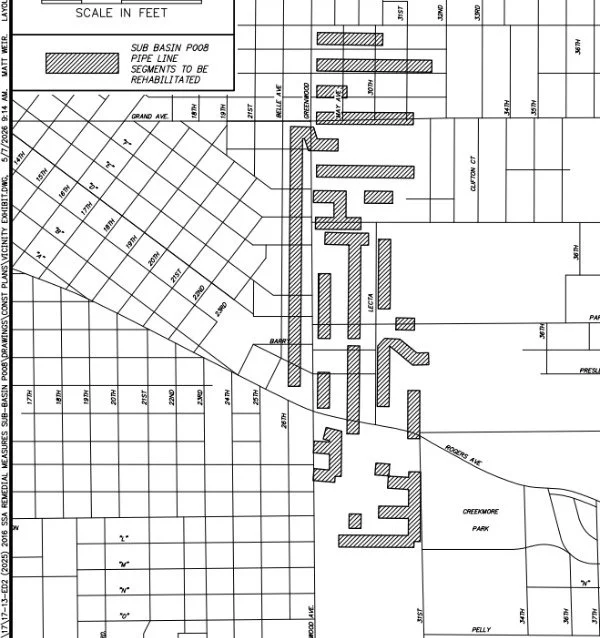
The Board voted unanimously to contract with Inliner Solutions for $6,857,019.47 for consent decree sewer work consisting of repair or replacement of 100 manholes and 15,000 ft of pipe and to contract with Hawkins-Weir for $585,600 for engineering services on the project.
Director Settle asked if the City has done business with Inliner before. Deputy Utilities Director Johnson answered that they currently are doing work on another City project.
Director Martin pointed out that the bid is 40% lower than the previous low bid received before the project was broken up and sent out for rebidding. It will be a $3 million savings over the previous bid.

The Board discussed whether to contract with Garver for $8,575,000 for engineering for consent decree improvements to the Massard Treatment Plant including designs for 2 new aeration basins, a blower building, solids storage tanks, a dewater unit, a pump station, a peracetic acid basin, secondary clarifiers, a parallel effluent discharge line, a river diffuser, and a wet weather treatment system.
Deputy Utilities Director Johnson mentioned that in addition to the consent decree, the Massard plant has for the last two years been under a state administrative order because of ammonia discharges being over the legal limit.
Director Kemp said that a couple of local firms reached out to him and asked some questions regarding the contract being billed as one lump fixed fee instead of an hourly charge. Director Kemp suggested tabling the issue. He said that the project would be “a lot of billable hours” and questioned if Garver would have the staff to devote to putting in that many hours.
A representative from Garver reminded that Garver has been involved in the project since the master planning study started in 2018 and finished in 2021. He said that the company has 1500 employees and over 300 in this region of Arkansas that are dedicated to water and wastewater. He said that they are capable of “throwing every resource we can at it” and assured that they have what they need to get the project done.
Johnson mentioned that the lump sum means that there will be no addendums for the design. The representative from Garver said that the entire project cost is $130 million-$135 million and that the cost for the Garver bid is below what national agencies that track engineering prices would estimate for engineering fees for the project.
Director Rego asked why the contract is for a fixed fee rather than hourly. He called the fixed fee “outside the norm.” Johnson said “the entire project is unusual” and that the lump sum is to cut down the time frame and allow for construction to begin before the entire design is complete, to “fast track” the project. Director Rego said that the amount of money involved for the unusual situation “merits conversation.”
Director Settle called the lump sum contract “atypical.” He voiced his support for tabling the issue.
Director of Water Resources McAvoy said that the improvements at the Massard facility would eliminate the largest sanitary sewer overflow site in the city and will bring it into compliance with the ammonia limits.
Director George Catsavis said of the $239,000 in permitting costs for permits from the State and Federal government (mostly in relation to the new discharge line to the river), “I think it’s ridiculous.”
Director Christina Catsavis asked when the last time was that engineering was contracted with a fixed fee contract rather than hourly. Johnson answered “I can’t recall one in recent history.”
The Board voted unanimously to table the issue to next week’s study session.
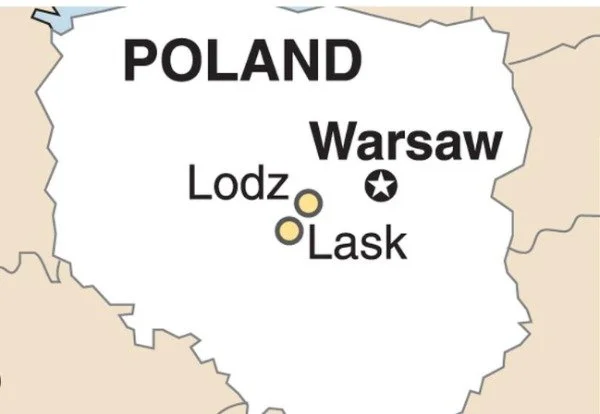
The Board voted unanimously without discussion to enter into a Friendship Pact (that will function like the agreements with current Italian sister cities Cisterna and Nago-Torbole) with Lask, Poland. Lask (pronounced “Wahsk”) is home to the air base that the Polish pilots that train in Fort Smith to fly the F-35s will return to when they finish training.
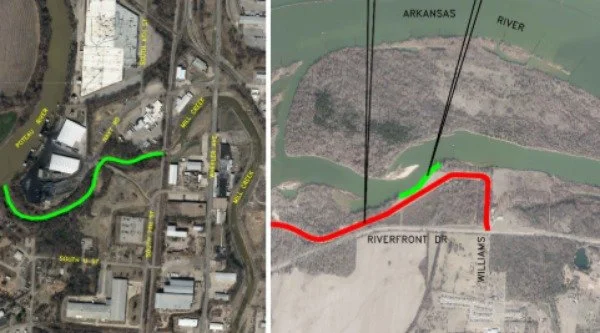
The Board voted unanimously without discussion to set in motion the application process for Arkansas Hazard Mitigation grants for the Mill Creek bank stabilization and Riverbank stabilization projects. The total cost of the Mill Creek project is $2,214,000. The total cost of the Riverbank project is $2,600,000. The grants could be for up to $300,000 each and require up to a $100,000 local contribution each.
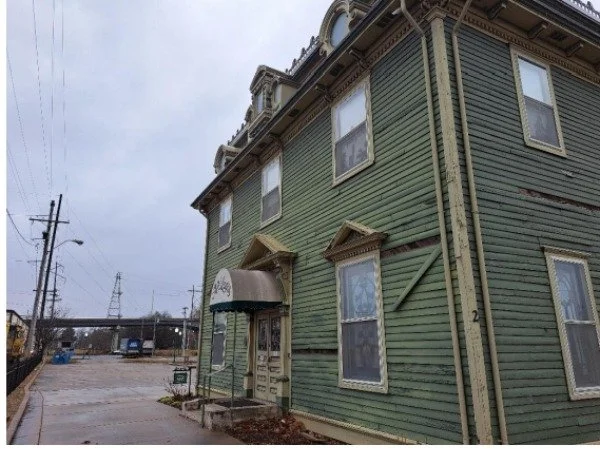
The Board voted unanimously to contract with Russell Exterior for $124,450 to replace deteriorated siding on Miss Laura’s Brothel Museum.
Joey McCutchen spoke in support of the siding project and of prioritizing preservation of history. He also advocated for preservation of Confederate monuments.
Shane McKinney spoke in support of the siding project. He mentioned Miss Laura’s being a favorite tourist destination for the guests staying in his AirBnB rental properties. He mentioned that the bid for the siding is lower than the amount budgeted for that project and suggested that the difference be invested in another project at Miss Laura’s. Dingman said that parking repairs and improvements at Miss Laura’s would be done with the remaining budgeted funds from the savings versus the budgeted estimate.
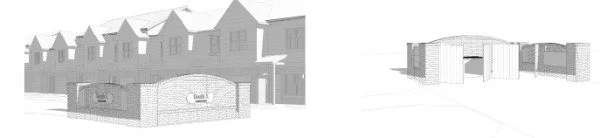
The Board voted unanimously without discussion to issue a temporary revocable license for Royal RIdge Holdings to put a dumpster screening wall, landscaping, irrigation, and signage in the public utility easement at 5416 South X.

The Board voted without discussion to apply for a Safe Streets for All federal implementation grant to be used for the consolidated 911 emergency communications facility. The grant would be for $8 million and require a $2 million local contribution. The local portion already is available in the existing 911 fund balance.

The Board voted without discussion to apply for a Rural Law Enforcement Violent Crime Reduction Initiative grant to be used for upgraded radios for the consolidated 911 center to allow for all of the radios to operate on the same single channel. Currently rural officers are operating on radios that do not do that. The grant would be for $300,000 and would not require any local contribution.